
This section of the website is relatively short, in comparison. It will cover the types of questions asked in the first parts of the Saikouisen Pro Exam. The first few sections of the exam are knowledge questions, covering rules, yaku, current top players, Saikouisen as an organization, and so on. These may be multiple choice, or short answer (where you explain a mahjong rule)
Rules
For rules, the current translated rules are available here:
https://www.saikouisen-usa.com/rules
(Click to open in new tab)
Answers subject to change when updated official translation is released. Check Saikouisen-usa.com for updates. Read this, and understand it. Take particular care to learn the initial seating method, what constitutes the different levels of Chombos, how to call tiles, all the Yaku (note that none are double Yakuman, and that Little Four Winds and Big Four Winds are instead combined and named differently) and the process at the end of a hand to confirm scoring for wins and exhaustive draws.
In addition, Go to the official Saikouisen USA website, About > Rules ( https://www.saikouisen-usa.com/rules ), and memorize the block of basic settings. As of January 2026, those settings are:
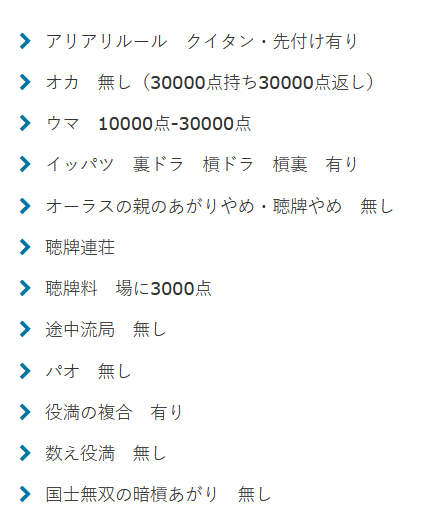
- Ari Ari rules: Kuitan and Atozuke are ON
- Oka none (30,000 points to start, 30,000 points is +/- 0)
- Uma 10/30
- Ippatsu, Ura Dora, Kan Dora, Kan Ura are ON
- Last round dealer’s agari-yame/tenpai-yame are OFF
- Tenpai payments add to 3,000 points
- Exhaustive draws are OFF
- Yaku that use “responsible one pays”: ZERO
- Multiple / stackable Yakuman are ON
- Counted Yakuman is OFF
- Thirteen Orphans wins through a closed Kan is OFF
In case it is needed, “Saikouisen Classic” rules are: uma 4-12, no extra doras, no ippatsu, no noten payment, repeat deal only on dealer win, can discard any tile so long as not in riichi [can discard same tile that you call pon/chi on], no concealed kan after riichi, riichi’d hand only is obligated to reveal if won [i.e. noten riichi is not penalized]
Here is a sampling of questions presented as a 15-question test.
- Calling procedure is to say the call name, then (A: Reveal the tiles > Discard your discard > Take the called tile B: Take Tile > Reveal > Discard C: Reveal > Take > Discard)
- Uma is (A: 10-30 B: 10-20 C: 5-15)
- Nagashi Mangan is (A: Valid if nothing of yours was called by your opponents B: Valid even if tiles of yours were called by your opponents C: Not valid)
- As for Yakuman Liability Payments, there are (A: 2 types B: 3 types C: none)
- For game setup, between determining which seat you sit in and the finalization of the first dealer, there are (A: No dice rolls B: One dice roll C: two dice rolls)
- Reaching without having a draw left in the wall is (A: always allowed B: never allowed C: allowed unless the player that wants to reach drew the haitei tile)
- Multiple / Double Yakuman scoring in a single hand is (A: multiple is allowed, no double yakuman B: 2 total yakuman allowed, counting a double as 2 C: stacking yakuman not allowed, take highest yakuman between single and double)
- If three people Ron, (A: only one wins B: three win C: triple ron abortive draw)
- The number of yaku in which downturn (“-1 han if open”) occurs is (A: 4 B: 5 C: 6)
- Each person starts with (A: 25,000 B: 27,000 C: 30,000) points, and this is considered +/-0 points for final score.
- Chombo penalty is (A: reverse mangan payment B: -20 points in overall ranking C: -30 points in overall ranking)
- Rinshan Kaihou and Haitei Raoyue are (A: Never combined B: Always combined C: Only combined if fully closed)
- “Too many tiles” penalty is (A. dead hand B. Sho-Chombo and dead hand C. Sho-Chombo and abort hand)
- Empty call (chi/pon/kan) penalty is (A. 1000 point deposit B. Sho-Chombo and dead hand C. Sho-Chombo and abort hand)
- 24mSSSEEENN + closed kan of 3m, at exhaustive draw, is (A. Tenpai B. Not Tenpai)
Answers: 1.C 2.A 3.C 4.C 5.C 6.C 7.A 8.A 9.C 10.C 11.B 12.A 13.B 14.B 15.B
Example short answer questions:
- A non-dealer declares ron with an open tanyao hand. their wait is double sided, and all of their sets are sequences. Although this adds up to 1 han and 20 fu, they score 1000 points. Why?
- If there is one tile left in the wall after a draw, and the player that drew calls a concealed kan, explain if their replacement draw, or if they do not win, their resultant discard, is haitei or houtei.
- A player is waiting on a 3m with a 24m wait with the hand GGGRRR24m99p. They also have a closed kan of 3m. at exhaustive draw, are they tenpai? Why or why not?
Answers: 1.futei rule means open 20fu hands are scored as 30. 2.replacement is not haitei, discard is houtei. 3. they are not tenpai, as all tiles not in your hand are considered available for wait determination, and all 3m are used.
Information
This covers Saikouisen knowledge questions. A comprehensive list of what has been asked before is here. For further research, see the official Saikouisen website. The English exams have both asked about important positions and title holders, and not asked at all on a later test, preferring to as short answers, so this section may be of varying importance to study. what I would suggest is perusing the Saikouisen-USA website, particularly on the Title Holders section, on to learn more about them.
Making mnemonics may help you. For example, some from the 2024 season:
- Current Saikouisen President (Representative): NIITSU Kiyoshi
- President Mario riding along, stops to give some advice, then rides off. “Nii is how you say ‘tsu (two)’, Kid. Yoshi!”
- Current Saikouisen Vice President (Vice Representative): KONDO Seiichi
- The VP guards the door to the President’s place of living, making sure you know the rank of the person who lives within. “To get inside this Condo, say ‘ichi’!”
Terminology
These may be asked as word questions.
- Routou Pai: 1s and 9s
- Ji Hai: Honors
- Shuu Pai: Numbers
- Chunchan Pai: 2-8
- Yaochuu Hai: Kokushi tiles
- Manzu: man tiles
- Pinzu: pin tiles
- Souzu: sou tiles
- Fon Pai: Winds
- Sangen Pai: Dragons
- Fan Pai: Yaku Honors
- Deme: Dice Value
- Shimocha: Player to right
- Toicha: Player across
- Kamicha: Player to left
- Jicha: You
- Tenbo: Point Sticks
- Jidotaku: Automatic Table
- Tachiainin: Judge/Referee
- Shiipai: shuffling the tiles by hand
- Piipai: A wall in a stacked state
- Ton: two tiles stacked in a wall
- Kaimen: starting the game
- Wanpai: Dead wall
- Hou: the area where the discards go
- Houtei hai: the last discarded tile of the game
- Teban: players turn from draw to discard
- Mentsu: tile formulation
- Shuntsu: 3 sequence
- Koutsu: 3 in tripet
- Ankou: All done on your own
- Min Kou: called from another
- kantsu: 4 in quad
- ankantsu: closed
- minkantsu: made from daiminkan or kakan
- daiminkan: 3 in hand call 4th
- kakan: add tile to a called minkou
- Taatsu: 2 out of 3 for shuntsu 12 13 23
- Toitsu: 2 of the same 11
- Haipai: initial hand
- Tehai: the closed tiles in your hand not counting current draw
- Touhai: to show your hand
- Fuurouhai: called tiles
- Menzenchin: a hand when fully concealed
- Chiicha: Starting dealer beginning of the game
- Toncha: East
- Nancha: South
- Shaacha: West
- Peicha: North
- Chancha: another word for Toncha
- Sancha: non-Toncha player
- Kamicha: player to your left
- Toicha: player across
- Shimocha: player to your right
- Dora Hyoujihai: Dora Indicator
- Mise hai: incorrectly showing tiles
- Ton ba: East Round
- Nan ba: South Round
- Renchan: round continuance
- Kyoku: round
- Mouta: drawing and discarding tiles
- Ryukyouku: exhaustive draw
- Tori Dashi: drawing your initial hand manually
- Tsumo: adding a tile to your hand
- Tsumo hai: tile you get during tsumo
- Dahai: discarding tiles
- Sutehai: tiles discarded by Dahai
- Kyoutaku: Riichi Stick
- Kuikae: forming a mentsu with a called tile and discarding a tile that could also have completed that mentsu
- Fuuro: takeing a Sutehai to complete a mentsu
- Shiji: hai sideways tile in a call
- Agari: win
- Atama hane: head bump
- Tsumo agari: win via tsumo
- Ron agari: win by ron
- Agariten: winning points
- Shyoku: suit
- Fuutei: base fu of 20
- Ron fu: closed 10 fu
- Tsumo fu: 2 fu
- Machi fu: waiting shape fu
- Penchan: edge wait
- Kanchan: middle wait
- Ryanmen: duoulbe sided wait
- Shanpon: double pair wait
- Tanki: single tile pair wait
- Bubun Fu: fu from shape tiles
- Rentei: total score of hand
- Honba: bonus for repeat rounds
- Fuurohai: called tiles
- Bassoku: penalties
- Chuui: warning
- Shidou: guidance
- Go Ron: Declaring Ron by mistake
- Go Tsumo: Declaring Tsumo by mistake
- Go Pon: Declaring Pon by mistake
- Go Chi: Declaring Chi by mistake
- Go Kan: Declaring Kan by mistake
- Taa hai: too many tiles in hand
- Shohai: too few tiles in hand
- Renchan: dealer repeat
- Rinchan: dealer pass
- Saku chi: incorrect chi
- Saki chi: too fast chi
Below is a customizable flash cards app for practicing.